
Tax Consultants in Dubai | UAE Tax Accounting Agents
 Free for new clients
Free Tax & Accounting Consultation
- Corporate Tax registration & filing
- VAT registration & returns
- Bookkeeping, accounting & audit
We reply within minutes during working hours.
UAE-registered Tax Agents

Your 2026 Revenue Increased — But Did Your Profit and Cash Flow Improve?
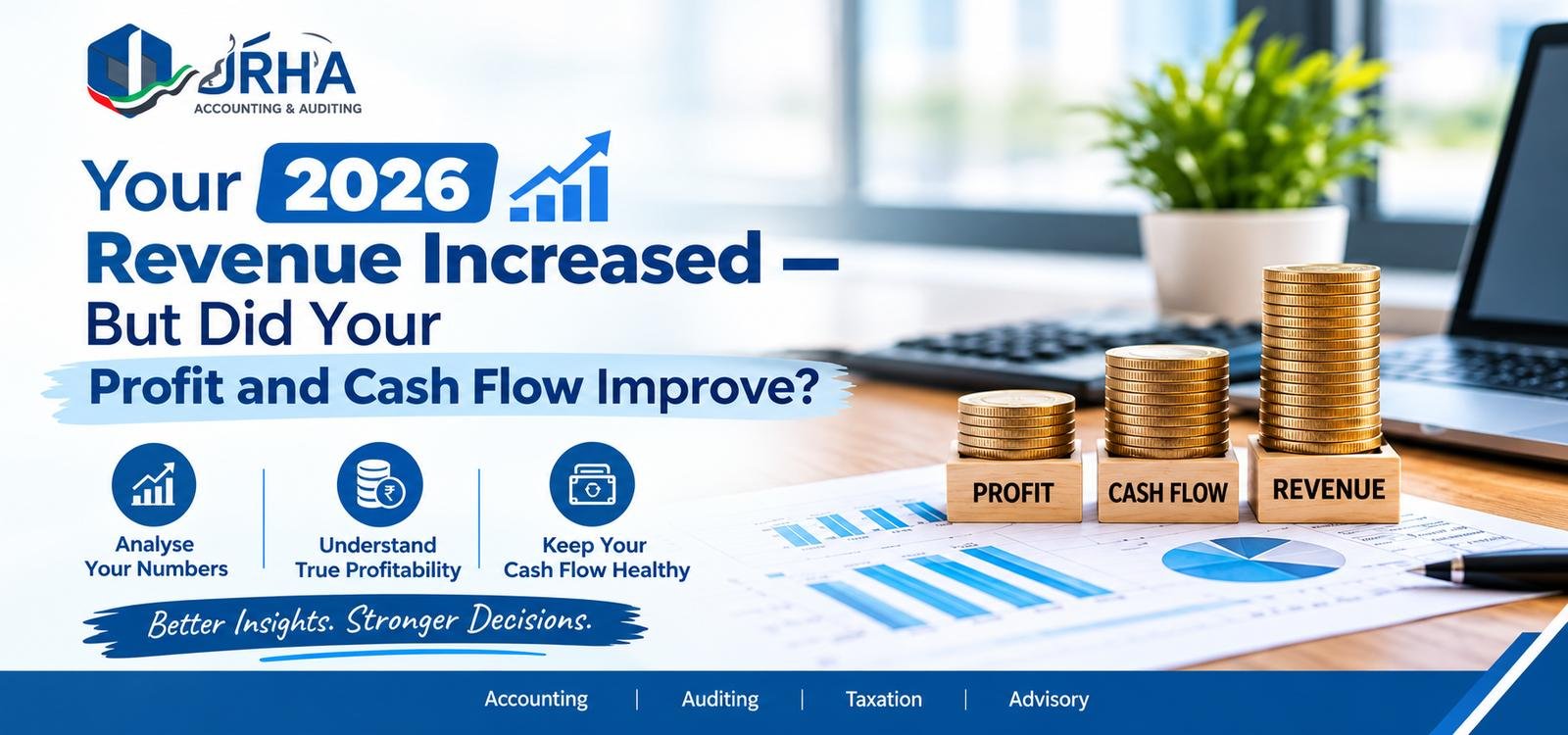
Picture a trading company in Dubai that finishes 2026 with its biggest sales total ever. The owner expects a comfortable year. Instead, the bank balance sits below where it was in January, and a VAT payment is due in a few weeks. That gap between what the sales report says and what the bank statement says is exactly what revenue vs profit vs cash flow is about.
This guide walks through the difference in plain language, shows where the money tends to disappear, explains how UAE corporate tax and VAT deadlines affect your cash, and finishes with six practical actions for the weeks left in the year.
Revenue, Profit and Cash Flow: The Difference Every Business Owner Should Know
Revenue reflects your total sales, profit shows what remains after expenses, while cash flow tracks the money actually coming into and going out of the business.
- Revenue counts every sale you have invoiced, even if the customer is still sitting on the invoice.
- Profit is what is left of that revenue after you pay for the goods, the team and the running costs.
- Cash flow tracks real money movement. It includes things profit ignores, such as repaying the principal on a loan or an owner taking money out.
Because they answer three different questions, one can climb while another drops, even inside the same twelve months.
Why Increasing Sales Doesn't Always Increase Profit
Prices that stood still while costs moved
Wages, rent, supplier quotes and insurance premiums usually drift upward. If your price list does not follow, each extra sale leaves you with a little less than the last one. Heavy discounting to land a big client works the same way: you sell more units but earn less on each.
Overheads that rose with the headcount
Growth often triggers new hires, a larger office or extra software. Those commitments stay on the books if sales cool off, so profit can go sideways when overheads climb faster than turnover.
Customers who look good on paper
Imagine two clients who each bring in the same amount. One asks for constant revisions, pushes the price down and pays late. The other is easy to deal with and pays on the due date. Their revenue is identical, but one of them barely earns you anything. Unless your reports break margin down by client or service, you will not see it.
Why a Profitable Year Can Still Leave You Short of Cash
The wait for customers to pay
A sale becomes revenue on the day you invoice it, yet the money shows up only when the customer pays. If your typical wait stretches from 30 days to 60 or 90, every new order makes the pile of money you are waiting for a little taller.
Stock sitting on the shelf
Goods you have bought but not yet sold do not count as an expense, so they leave your profit untouched. Your spendable cash, however, has already gone.
Spending first, collecting later
A bigger order usually means paying suppliers, subcontractors and staff before the customer’s payment arrives. The faster the growth, the larger the amount you must front.
Money that leaves without being an expense
Loan principal instalments and owner withdrawals drain the account but never show up as business costs. A year can end in profit and still finish with less cash than it began with.
A Made-Up Example to Show the Gap
These figures are invented purely to demonstrate the mechanics. They do not describe a real business, and the cash line is deliberately simplified.
| 2025 | 2026 | |
|---|---|---|
| Revenue | AED 1,800,000 | AED 2,520,000 (up 40%) |
| Net profit | AED 180,000 (10%) | AED 151,200 (6%) |
| Extra money owed by customers | – | AED 420,000 |
| Extra money tied up in stock | – | AED 110,000 |
| Rough cash from operations | 151,200 - 420,000 - 110,000 = AED 378,800 |
Sales jumped by 40%, yet the margin shrank from 10% to 6%, and roughly AED 378,800 more left the business than came in from day-to-day operations. Anyone reading only the sales line would have called it a triumph.
How UAE Tax Rules Change the Cash Picture
Tax follows the accounting profit
Under UAE corporate tax, the first AED 375,000 of taxable income is taxed at 0% and anything above it at 9%. The calculation starts from the profit shown in your financial statements. Once revenue passes AED 3 million, the accrual basis is mandatory, whereas businesses at or below that level may choose the cash basis.
So a business using accruals can report profit on invoices it has not collected, and that profit can flow into its tax bill. Tax and cash do not always travel together.
The date the money is due
Both the corporate tax return and any tax owed are generally due within nine months after the tax period ends. For a company with a 31 December 2026 year-end, that points to 30 September 2027. Filing late costs AED 500 for every month or part of a month in the first year, then AED 1,000 a month after that.
Small Business Relief after the 2029 extension
Under Ministerial Decision No. 131 of 2026, businesses with revenue up to AED 3 million can now claim Small Business Relief for tax periods ending on or before 31 December 2029. Guides published earlier this year often still say the relief stops in 2026, so check the date on whatever you read. Growing businesses should note two points:
- You have to ask for the relief inside your corporate tax return. It does not apply by itself.
- Revenue must have stayed at or below AED 3 million in every earlier period since June 2023. Passing that line once can close the door.
If your 2026 turnover is heading towards AED 3 million, confirm where you stand before building any plans on the relief.
VAT and its separate timetable
VAT returns and payments fall due on the 28th day after each tax period ends (the Federal Tax Authority publishes the details). VAT on your invoices is generally reported on a fixed schedule instead of waiting for the customer’s payment, so ask your advisor how your own invoices are treated. Set cash aside for VAT and corporate tax alike, because neither pauses while a customer delays.
Six Things to Do Before the Year Ends
- Put margins next to sales. Calculate gross and net margin for 2025 and for 2026 to date, then compare.
- Go through the unpaid invoices. Note who owes what and how long it has been overdue.
- Check what is sitting in stock. Spot cash locked in goods or prepayments that have not yet produced income.
- Map the next three to six months of cash. Include salary runs (WPS dates), supplier bills, loan instalments, VAT and your likely corporate tax.
- Estimate corporate tax now, not later. Look at probable taxable profit, your accounting basis and whether Small Business Relief fits.
- Rank clients and services by what they really earn. Then adjust prices, payment terms or workload where the numbers are weak.
Getting Help With the Numbers
A once-a-year review feels like a scramble, while a monthly one becomes routine. IRHA Accounting & Auditing offers MIS reporting to help businesses track income, expenses and profitability, along with bookkeeping, financial reporting, corporate tax and VAT support. If your sales are climbing while your bank balance is not, a short look at your books is a sensible place to start. You can contact the team here.
Frequently Asked Questions
Can a Business Be Making Money and Still Run Out of Cash?
Yes. Profit recognises income when it is earned, while cash flow only records money when it actually moves. Unpaid invoices, stock purchases, loan instalments and owner withdrawals can empty the bank account even when the profit figure looks good.
Why are my sales rising while my profit is falling?
Usually because margins are thinning, costs are growing faster than sales, or some clients and services earn very little once the work is done. Discounts and new overheads taken on for growth often contribute.
What separates profit from cash flow?
Profit is revenue minus costs over a period. Cash flow gives a clear picture of the money flowing into and out of the company. Profit can be recorded long before the cash turns up.
What counts as a good profit margin?
It varies widely by industry, so no single number suits everyone. A useful starting point is your own margin from earlier years, followed by comparable businesses in your sector.
Do I owe UAE corporate tax on invoices that customers have not paid yet?
It depends on your accounting basis. Accruals are required above AED 3 million in revenue, and the cash basis is an option at or below it. On the accrual basis, invoices you have earned but not collected can form part of your profit. Check your own treatment with a tax advisor.
When Does the 2026 Corporate Tax Return Need to Be Filed?
Corporate tax returns are generally due within nine months of the tax period's end. For a business with a 31 December year-end, that means 30 September 2027.
Can I still use Small Business Relief in 2026?
Yes. It now applies to tax periods ending on or before 31 December 2029, and the AED 3 million revenue limit has not changed. You claim it in your corporate tax return.
Does crossing AED 3 million in revenue affect Small Business Relief?
Yes. Exceeding AED 3 million in any period since June 2023 can end your eligibility, even if revenue drops again later. Look at your revenue history before making growth or timing decisions.
