
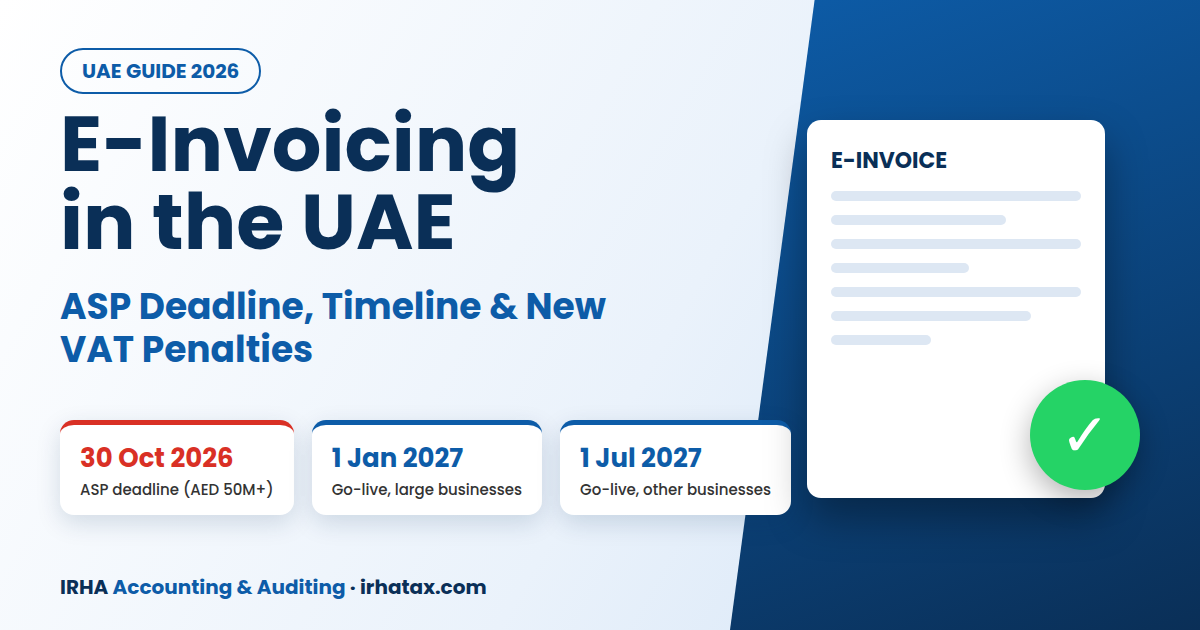
E-invoicing in the UAE is no longer a future plan. The pilot started on 1 July 2026, large businesses must appoint an Accredited Service Provider (ASP) by 30 October 2026, and the first businesses go live on 1 January 2027. At the same time, revised VAT penalties have applied since 14 April 2026. This guide explains both changes in plain language and gives UAE SMEs a practical checklist for the next few months.
Quick summary: e-invoicing and VAT penalty dates in the UAE
| Who / What | Key date |
|---|---|
| Revised tax penalties (Cabinet Decision No. 129 of 2025) | In force from 14 April 2026 |
| E-invoicing pilot (voluntary) | From 1 July 2026 |
| Businesses with revenue of AED 50 million or more: appoint an ASP | By 30 October 2026 |
| Businesses with revenue of AED 50 million or more: go live | 1 January 2027 |
| Businesses below AED 50 million: appoint an ASP | By 31 March 2027 |
| Businesses below AED 50 million: go live | 1 July 2027 |
| Government entities: go live | 1 October 2027 |
What is e-invoicing in the UAE?
E-invoicing means issuing and receiving invoices in a structured electronic format through an approved system, instead of sending PDFs, Word files or paper invoices. The framework was set out in Ministerial Decisions No. 243 and No. 244 of 2025.
Under the UAE model, both the seller and the buyer must use an Accredited Service Provider (ASP). The ASP validates each invoice, sends it to the buyer's ASP, and shares the required data with the Federal Tax Authority (FTA). A scanned PDF sent by email will not count as an e-invoice.
Which transactions are covered?
- B2B (business to business): covered, with limited exceptions.
- B2G (business to government): covered.
- B2C (business to consumer): currently excluded until further notice.
- Some items, such as certain exempt financial services and some international airline services, are excluded.
The 30 October 2026 ASP deadline
The original deadline for large businesses to appoint an ASP was 31 July 2026. The Ministry of Finance extended it to 30 October 2026, but the go-live date of 1 January 2027 did not change. If your group revenue is AED 50 million or more, you now have very little time to choose a provider, integrate it with your accounting or ERP system, and test it.
Smaller businesses have until 31 March 2027 to appoint an ASP, but starting early is sensible. Integration usually takes longer than expected, especially when invoices come from several systems or spreadsheets.
What changed in UAE VAT penalties from 14 April 2026
Cabinet Decision No. 129 of 2025 revised administrative penalties across UAE tax laws, including VAT. This is not a waiver or amnesty: returns, payments and invoices still need to be correct and on time. The main changes are:
- Late payment: now calculated at 14% per annum, charged for each month or part of a month the tax stays unpaid.
- Voluntary disclosures: the old 5% to 40% slab system was replaced by a 1% monthly penalty, which rewards correcting errors quickly.
- Record keeping: the penalty for a first failure to keep records fell from AED 10,000 to AED 1,000.
- Repeat violations: repeating a violation within 24 months attracts a higher penalty of AED 20,000.
In practice, businesses that correct mistakes early now pay far less than before, while businesses that repeat the same mistake pay more.
E-invoicing checklist for UAE SMEs
Now (next 30 days)
- Confirm your annual revenue band (above or below AED 50 million) and your deadlines.
- List every place invoices are created: accounting software, POS, Excel, manual books.
- Clean up customer and supplier data: legal names, TRNs, addresses.
- Check that your current tax invoices meet FTA requirements.
Next 3 months
- Shortlist ASPs and ask how they connect with your accounting or ERP system.
- Appoint your ASP before your deadline (30 October 2026 for large businesses, 31 March 2027 for others).
- Train your finance team on the new invoice workflow and approvals.
Before go-live
- Test the full cycle: sale, e-invoice, VAT return, payment, archiving.
- Reconcile e-invoice data with your VAT return every period.
- Document your process so it is ready for FTA review or audit.
Common mistakes to avoid
- Assuming a PDF invoice by email is enough. It is not.
- Waiting for the last month to appoint an ASP.
- Ignoring supplier readiness. Your suppliers also need an ASP to send you e-invoices.
- Treating the new VAT penalty rules as a "fresh start". Past errors still need to be fixed through voluntary disclosure.
Frequently asked questions
When does e-invoicing become mandatory in the UAE?
Businesses with revenue of AED 50 million or more must go live on 1 January 2027. Businesses below AED 50 million must go live by 1 July 2027, and government entities by 1 October 2027.
What is the ASP deadline for large businesses?
Businesses with revenue of AED 50 million or more must appoint an Accredited Service Provider by 30 October 2026. The deadline was extended from 31 July 2026.
Does UAE e-invoicing apply to B2C sales?
No. B2C transactions are currently excluded until further notice. The mandate covers B2B and B2G transactions.
Did the UAE cancel old VAT penalties in 2026?
No. From 14 April 2026, Cabinet Decision No. 129 of 2025 revised how penalties are calculated, including lower penalties for some first-time violations and a 1% monthly penalty for voluntary disclosures. It did not cancel existing penalties.
Get Your Business E-Invoicing Ready
IRHA's Dubai team reviews your invoices, cleans up VAT records, prepares voluntary disclosures and gets your accounting ready for e-invoicing. See our VAT Services and Accounting & Tax Services.
WhatsApp an ExpertCall +971 545122325This article is for general information and reflects rules published up to September 2026. Always confirm current requirements with the Federal Tax Authority or a qualified tax adviser before acting.
